
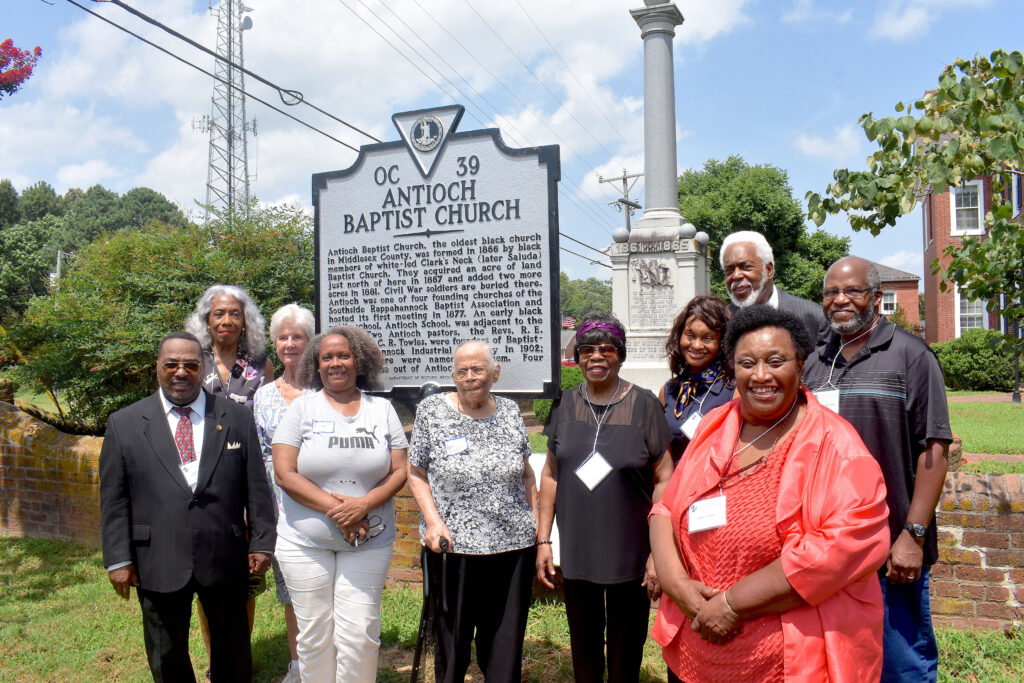
Members of Antioch Baptist Church in Saluda gathered with state and county officials on Saturday to dedicate a state highway marker commemorating the church’s 158-year history.
Bessida Cauthorne White, chair of the marker research team and dedication planning committee, welcomed guests, and Don R. Harris, chairman of the Middlesex County Board of Supervisors, gave greetings. LaToya Gray-Sparks, community outreach coordinator for the Virginia Department of Historic Resources, provided information about the Historical Marker Program. Sparks also thanked White for her “commitment to telling the whole story of Virginia’s past.”
Keynote speaker the Rev. Dr. Leonard L. Edloe, pastor of New Hope Fellowship in Hartfield, spoke of the many changes that have occurred since the church’s founding in 1866, when black churches were not allowed to have black preachers and “a lot of sermons were about being a good slave.”
He spoke of “very dark days,” including “the dark nights of the KKK” and the Great Depression, but said that Antioch would always “press for a vision of a brighter tomorrow,” and that it provided “a place of refuge in times of trouble.”
“In the 158 years since its inception, what a difference this church has made,” he said.
Mutual aid societies were born in the rural black church, said Edloe. Such organizations “allowed us to put resources together and rally around black businesses. They held the community together.” The church gave young black boys and girls their first opportunity to speak in public, provided a training ground for young black preachers, and were often the only place a young black person could learn to serve, he said.
Edloe exhorted those present to “remember those who blazed the past” and to “thank those who made sure the marker will be installed.”
According to a history in the dedication program, Antioch spawned four area churches over the years: Calvary Baptist and Lebanon Baptist, both in 1891, Zion Branch Baptist in 1892, and Immanuel Baptist in 1915. The Southside Rappahannock Baptist Association was formed there in 1877, with Antioch as one of the four founding churches, and the church provided financial support for the Gloucester Agricultural and Industrial Academy in the 1880s. Former pastors and members were also active in the founding, operation, and oversight of the Rappahannock Industrial Academy.
Also in the late 1800s, Antioch took an active role in the struggle against racism by raising money to support the defense of three black women in Lunenberg County who were charged with murdering a white woman, and it was the founding site for the Middlesex County Sunday School Literary Union. During the Civil Rights era, the church was involved in various movements and often hosted nationally-known movement figures, such as Ella Baker.


