
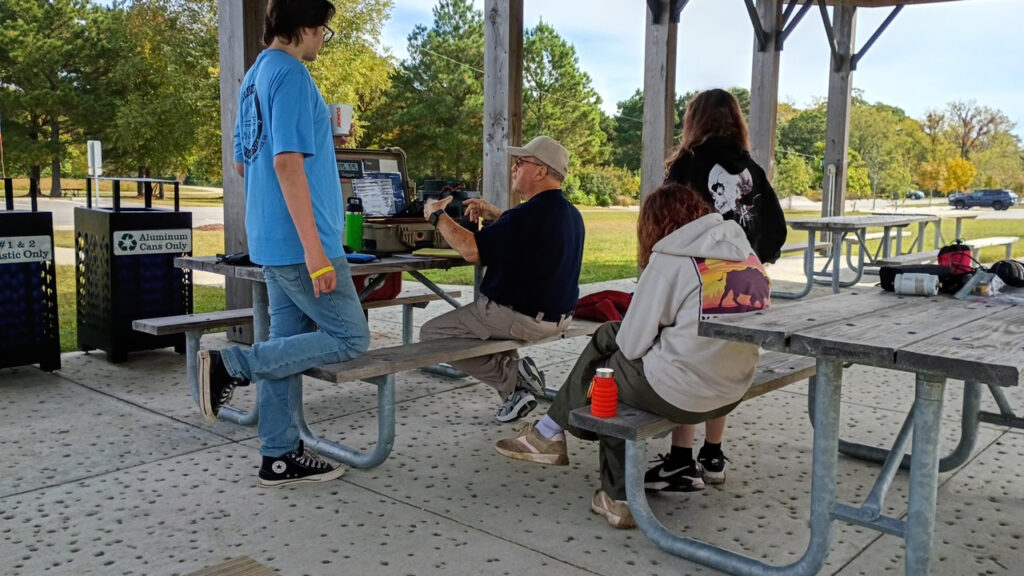
Scouts from Troops 133, 1651 and 175 recently got a taste of high-tech communication during the annual Jamboree on the Air, which was held at Machicomoco State Park, Hayes.
This worldwide event, which was held Oct. 17-19, lets Scouts talk to people across the globe using amateur, or Ham, radios.
Locally, the event was made possible thanks to the members of the Middle Peninsula Amateur Radio Club, especially Bob Beltz and John-Micheal “JM” Payne. They coordinated and ran the entire portable radio station right after the Scouts finished their park service project.
Setting up the station was an adventure in itself, turning into a hands-on science lesson. The Scouts pitched in, helping to raise a mast and connect a special DIY dipole antenna. They had to be careful to choose the right connections for the 20-meter band—that’s the frequency that helps signals travel super-long distances. The entire setup, including the Icom HF 706 Radio, ran cleanly off a battery and a power supply. They had maps and clocks nearby, just like a real professional station.
Before anyone spoke a word into the microphone, Beltz and Payne gave the Scouts a quick pep talk and lesson. They made sure the young operators knew how to talk clearly and slowly, be polite, and use radio slang like “Q codes.” The adult operators encouraged the Scouts to chat about their own lives, asking the people they connected with about their summer camp stories and the merit badges they were working on.
Once the station was fully ready, the airwaves buzzed as the Scouts started calling out: “CQ CQ JOTA Jamboree on the Air event.”
Signals came pouring in, and the young operators quickly logged successful contacts in eight states: Michigan, Wisconsin, Connecticut, Ohio, Texas, Virginia, Kansas and North Carolina.
To make sure every single Scout got a turn to talk, fellow MPARC member Mark Lowell provided backup from his own home station in Gloucester.
“Bob and John-Micheal had their hands full, setting up their portable station at the park, and coordinating the individual Scouts to approach on cue and take turns operating the radio,” Lowell said. “I was able to jump in and talk with at least one Scout during a lull in the action when the long-distance radio signals weren’t coming through easily.”
He added that it can be a challenge to coach youngsters into a conversation with a stranger they can’t see, especially while they’re learning to use a hand microphone and Ham radio jargon.
Lowell concluded that the day was a huge success. “We all felt a sense of satisfaction by helping introduce youngsters to an enduring technical hobby that still seems like part magic, with invisible signals jumping long distances between stations, with no infrastructure in between,” he said.
The day showed the Scouts firsthand how communication technology works, connecting them with people across the country using nothing but a radio and some airwaves. The team signed off with a final “73” (that’s radio slang for “best regards”) as they packed up.

