
Press "Enter" to skip to content

‘It was the joy of my life’: Mathews resident Chuck Lirette recalls his career in the skies

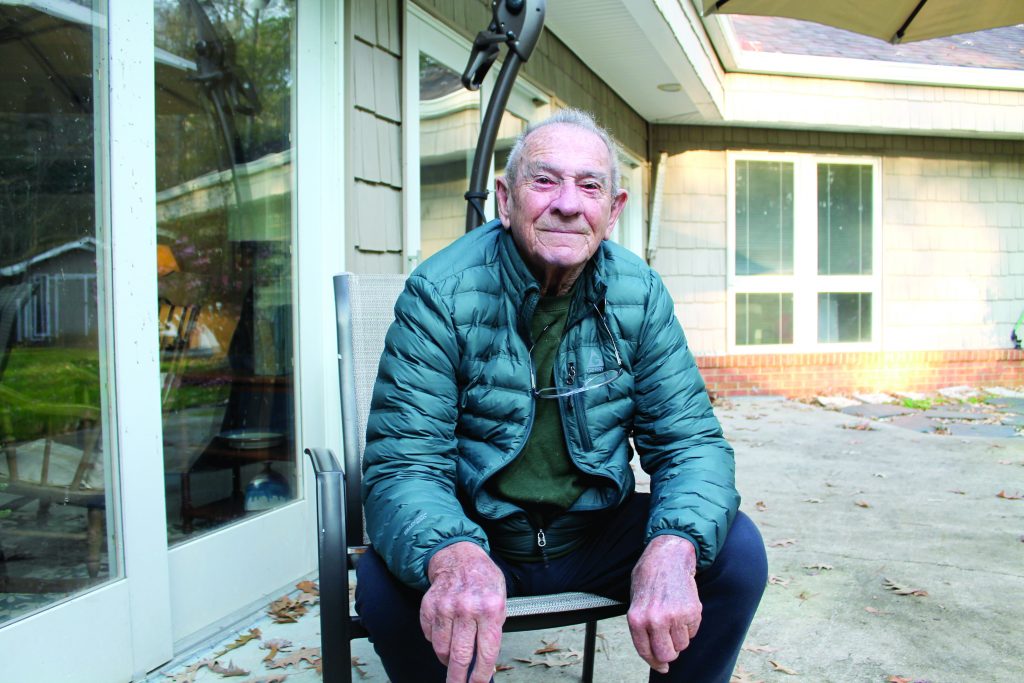
With his 100th birthday approaching next month, Chuck Lirette of Mathews has some stories to tell about his adventures as an aviator and aviation instructor with the U.S. Army Air Corps and the U.S. Air Force.

He says he can remember everything that has happened in his life in vivid detail, including dates and times, and that claim appears to be borne out as he talks about a career that began in 1940, at the dawn of America’s involvement in World War II, when Lirette was 19 years old.

Lirette said he clearly recalls Dec. 7, 1941, the day Pearl Harbor was attacked. Assigned to the newly-established MacDill Field in Tampa, Florida, he was at the airman’s club “with a gal on my lap” when the announcement was made that the attack had occurred, and “the base went wild.”

Although Lirette’s skill as a pilot was evident early on and he wanted to follow in his older brother’s footsteps and join the fight in Europe piloting a bomber, he was instead kept stateside for most of the war, working as a flight instructor and accumulating thousands of hours of flight time.

But in 1944, the U.S. Army Air Corps called for every pilot with 2,000 or more hours of flight time to serve in the airlift that was transporting supplies to Army Air Force units based in China and to Chinese soldiers who were fighting the Japanese.

Lirette said he had never been out of the United States, yet he flew his brand-new C-46 Commando transport aircraft from South America to an island in the Atlantic and then to Africa, Cairo, Iran, Calcutta and finally Burma with a copilot and engineer. On their arrival in Burma, the monsoon had started, and his first flights over the famous section of the Himalayas known as The Hump were in “the worst weather I’ve ever seen.

“All you could do was hold the plane level,” said Lirette. “It was always either cloudy or at night.”

During one mission, Lirette said the weather was so bad that it caused his wings to flex to the point that the fuel line on his right engine broke, and it caught fire.

“I hit the red button to deaden the engine and feathered the prop so perfectly parallel to the air that we didn’t slow down,” said Lirette. He turned around to head back to the airfield, but the plane was losing altitude, which would eventually make it impossible to make it across the mountains, so the crew rolled the gas drums out the rear door of the plane, said Lirette.

“I told them to get the chutes ready, but it was suddenly quiet, so I knew we were over the valley,” he said, “and we landed at home base.”

Lirette said it was a harrowing experience, but he got back in the air as quickly as possible so he could put it behind him. By the time the war ended, he had racked up 70 missions over The Hump.

But that didn’t end Lirette’s service in the Pacific. With their planes left behind to continue to serve the ongoing Chinese war effort, he and four other pilots, along with their copilots and engineers, were waiting for a transport ship home when they were told they would have to remain to support President Chiang Kai-shek’s efforts against a takeover by Communist revolutionary Mao Tse-tung.

Neither side in that war had air support, said Lirette, and he was assigned to fly from Shanghai to the war front in Northern China, just short of what was then known as “the unexplored territory.” The only map the pilots had was a geographic map of China from the 1930s, and they used Greek alphabet to identify the airfields they flew to.

The planes had to leave at 4 o’clock every morning to carry Chinese soldiers to the war zone, said Lirette. Each plane could carry 68 soldiers. He said the soldiers had a myth that said they were being chased by devils, and if they could run in front of a taxiing airplane without being hit, it would kill the evil spirit. That led to a daily death toll, he said.

“We would all hit one,” said Lirette, still clearly disturbed by the memory. “It got to the point that every time we took off, we would hit one. You couldn’t maneuver much at 60 or 70 mph.”

Lirette was moved by the sights he saw in China. He remembers the impact it had on him to see little girls hobbling around on their bound feet, and he has a clear memory of waiting near the Gobi Desert in the winter to have his props cleaned off and seeing a man and a woman standing naked in a dry river bed. He said they had pieces of bark around them and were shivering and holding onto each other to try to stay warm.

“I had a camera, but I just couldn’t take a picture,” he said. “They were so pitiful.”

Lirette and the other pilots remained in China until Chinese pilots learned to fly the planes and took over operations. Once stateside, his career continued. A lieutenant colonel by now, Lirette was assigned to Tacoma, Washington. But because he was a reserve officer who had never been to college, he was afraid they would let him go. He decided he needed to get a flight line job as soon as possible, so he kept asking the commanding officer what was available.

“Finally, one day they said the only thing available is the occupation of Germany,” said Lirette, and he jumped at the chance. After taking classes at Military Government School, Lirette was sent to Germany, where he served as a civil judge and governor in Bavaria, near Munich and the Czechoslovakian border.

A couple images of Chuck Lirette in his younger days during his years in military service.

The assignment was a cushy one for Lirette. He had “the best house in town,” a maid, five cars “for just me,” and 27 people on his staff to provide support, including three attorneys. The Army even flew his bulldog “Algernon” from the U.S. to be with him.

Lirette said that, as a judge, the U.S. requirement to establish guilt “beyond a reasonable doubt” meant that he frequently let people go free who would have been found guilty by a German court. It was also his job to set up elections, which he said the Germans loved.

In 1948, communists seized control of neighboring Czechoslovakia’s government, and Lirette was sent home, arriving on his 28th birthday, Jan. 18, 1949.

During the ensuing years, Lirette learned to fly jets and became an instructor for such aircraft as the T-33 and the Interceptor. One of his assignments was at Goose Bay in Labrador, where the crew’s job was to intercept any plane that came within 200 miles of the U.S. coast. There was a constant interchange between U.S. and Russian pilots, he said, adding, “It went on for years—war games.”

Lirette served three years in Colorado Springs, Colorado, where his job was in manpower, determining the structural makeup of squadrons, and he followed that with a two-year stint back at MacDill Air Force Base, where he had the job of testing all the Interceptor pilots and radar observers for their ability to hit a target by radar. During that time, he had the opportunity to fly “twice as fast as I’d ever gone” in an F-104. He followed that up with a flight at Mach II in the same aircraft, flying at 1,550 mph.

A subsequent job at Patrick Air Force Base near Cape Canaveral had Lirette providing support for missile and submarine operations throughout the lower Atlantic, from Bermuda to South Africa and the Indian Ocean. He flew calibrating flights for the Polaris missile, which at the time was the nation’s top priority, and he got to know a number of astronauts—John Glenn, Virgil Grissom and Alan Shepard among them. “They were all great guys,” he said.

Eventually, Lirette worked his way up to serving the Joint Chiefs of Staff at the National Military Command Center in Washington, D.C.—“the nation’s war room.” His job was to oversee aircraft in the Atlantic and African sectors. He collected all significant data and reduced it to a half page for the president’s daily briefing.

That posting was the last one for Lirette. After that, he went into the private sector, working first for Sears, Roebuck, which provided a course that enabled him to turn his military skills into a civilian job. He then went to work in Mississippi for North American Aviation, which had a contract with NASA to test the third phase of the moon rocket, but he was courted away from that job by General Electric, where he worked on the company president’s staff as GE worked to improve NASA’s rockets.

When the company’s contract ended, Lirette was sent back to D.C. to work on indexing NASA paperwork, and while there he met the love of his life, Mary.

“She was brilliant,” said Lirette. “A Smith graduate, a classical pianist. Two dates and we knew we were in love—that we were gonna go forever.”

Both of them were divorced, with children from their previous marriages, but they didn’t hesitate and were married.
Lirette then accepted a job overseeing the computerization of financial data for the National Institutes of Health.

“It was an easy job,” he said, “and I spent a hell of a lot of time with Mary.”

The couple traveled all over Europe and attended every classical concert they could as her parents watched her children. They drove all up and down the East Coast, looking for the perfect place to retire.

At the age of 62, said Lirette, “I threw it all away and said ‘Mary, we’re moving to Mathews … We came to Moon, and after six months, she didn’t want to leave.”

Lirette said that Mathews reminds him of his native Louisiana, where he grew up poor, the son of a sugar plantation overseer. With nine children in the family, he said, it was good that the family grew vegetables and had wildlife to eat.

At a young age, Lirette learned to trap possum, raccoons, and mink, getting up at 4 a.m. and using a carbide lantern to walk his trapline. He would carry a bag over his shoulder and a stick to strike the animal dead. He would then take the animals home, skin them, put them on a board, hang them on the clothesline, and catch the bus for school at 7:30 a.m.
Possum skins sold for 25 cents, raccoon skins for 50 cents, and the rare mink skin for $10. Lirette only trapped during the winter months, but the money he made lasted all year.

When he was just five years old, with no thought of anything other than the life he was living, Lirette saw an airplane flying overhead, and he told his father that was what he wanted to do.

“And I did!” he said. “Oh god, I was so happy to fly. It was the joy of my life.”