
Black pepper is today an indispensable spice in every kitchen. It’s the most commonly used spice in the world (salt, being a mineral, is not a spice). Black pepper originated from Southern India around the city Kerala where it was often referred to as “black gold” and was of great importance as a traditional medicine. Peppercorns were found in the nostrils of Pharaoh Ramses II.
Black pepper became a common household condiment, taking an interesting and intriguing journey to reach its ease of use today: reach for a shaker and there it is.
Signs of an ancient pepper trade from India to Egypt have been found and by 40 AD, the Romans had a thriving trade in spices including pepper. Over the next few hundred years, black pepper’s popularity and value skyrocketed. Rome, prior to its fall, paid 3,000 pounds of pepper as part of a cease-fire negotiations.
The Arabs then took over the spice trade and by the Middle Ages many other groups had joined the lucrative trade. By the end of the 15th century the Portuguese were running the spice trade. The Dutch took over in the 17th century to became the dominate shipper, giving way to the British in the 18th and 19th centuries.
By this time middle-class consumers could afford it, and black pepper began to emerge as a daily seasoning for meat and other foods. Today Vietnam is the leading exporter of black pepper.
On its journey through time black pepper has been used not only as a spice but also as money, to clean teeth, to eliminate bad breath, and to ease toothaches, constipation, insomnia and sunburn.
Black pepper starts life as berries in a clump on a flowering vine (like grapes). The fruit is picked at varying degrees of ripeness depending on the strength and type of pepper desired and then processed accordingly. Here are the four major peppers.
Black pepper is obtained by picking green fruit, being dried in the sun, then processed. Red pepper is harvested from fully ripe, red berries, dipped in salt water, then frozen or quickly dried. White pepper comes from red, nearly ripe berries that are moistened so the outside layer can be removed before drying. Green pepper is obtained by picking the grain before ripening.
When cooking, add black pepper just before removing the dish from the oven or just before being cooked completely. Do you use commercial ground black pepper or do you grind the peppercorns? Either works well. Most professionals prefer to use a pepper grinder.
NOTE: Information on black pepper comes from “Everything You Should Know and Few Other Interesting Facts About Black Pepper,” “A Brief History of Pepper,” “Introducing Black Pepper Into America,” and “Flavor Story: Pure Ground Black Pepper.”
GARLIC PEPPER MASHED POTATOES
2¼ lb. russet or Idaho potatoes, peeled and quartered
1 tsp. garlic powder
1 tsp. sea salt
¼ tsp. ground black pepper
½ c. half-and-half
½ c. sour cream
Put potatoes in medium saucepan. Cover with water, bring to boil. Reduce heat to low; cover and simmer 10 to 15 minutes or until potatoes are fork tender. Drain and return potatoes to saucepan. Sprinkle with garlic powder, sea salt and pepper. Mash with potato masher, gradually adding half-and-half, then sour cream.
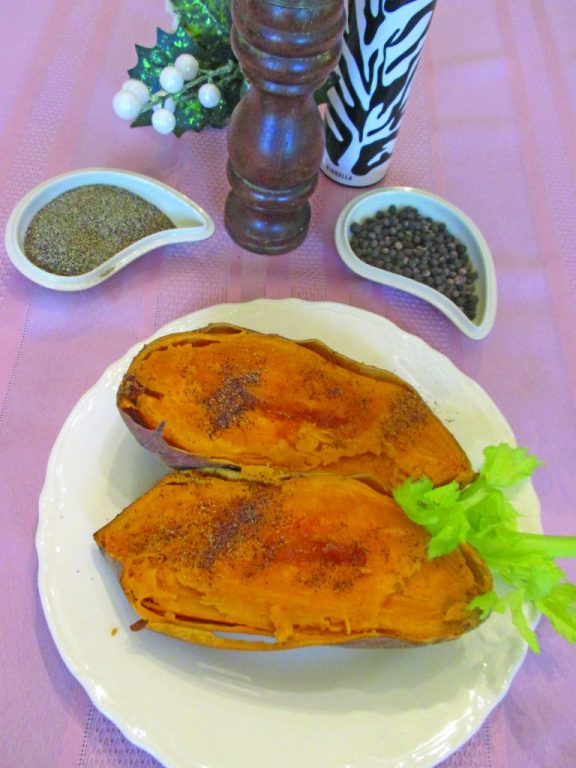
BAKED SWEET POTATOES WITH BROWN SUGAR AND
BLACK PEPPER
8 sweet potatoes
1 c. unsalted butter
1 c. dark brown sugar
Fresh-ground black pepper
Kosher salt, to taste
Heat oven to 425°F. Put sweet potatoes on a foil-lined baking sheet and bake until soft, about 1 hour and 15 minutes.
Remove potatoes from oven and allow to cool for 10 minutes. Split potatoes open and put 2 Tbs. butter and 2 Tbs. sugar into each potato. Season liberally with black pepper. Finish with kosher salt to taste.
CHEESE AND PEPPER PASTA
Kosher salt, to taste
1 lb. pasta, spaghetti
4 Tbs. extra-virgin olive oil
2 tsp. freshly cracked black pepper, plus more to taste
1 c. finely grated Pecorino Romano (a hard Italian cheese), divided
3⁄4 c. finely grated Cacio de Roma (a soft Italian cheese)
Bring a 6-qt. pot of salted water to a boil. Add pasta; cook until al dente, 8-10 minutes; reserve 1 c. pasta water and drain pasta. Meanwhile, heat oil in a 12-inch skillet over medium heat until shimmering. Add pepper; cook until fragrant, 1-2 minutes. Ladle 3⁄4 c. pasta water into skillet; bring to a boil. Transfer pasta to skillet; spread it evenly.
Sprinkle 3⁄4 c. each Pecorino Romano and Cacio de Roma over pasta; toss to combine until sauce is creamy and clings to the pasta without clumping, about 2 minutes, adding more pasta water if necessary. Transfer to 4 plates and sprinkle with remaining Pecorino and more pepper.
BLACK PEPPER CHICKEN STIR-FRY
½ c. soy sauce
1 Tbs. honey
¾ tsp. coarsely ground pepper
¾ tsp. garlic powder
½ tsp. ground ginger
½ tsp. ground turmeric
½ tsp. curry powder
½ c. cornstarch
1½ lb. boneless skinless chicken, cubed
¼ c. canola oil, divided
1 large onion, diced
Fresh cilantro, minced
Green onions, sliced
In a small bowl, combine the first seven ingredients. Place cornstarch in a large bowl. Add chicken in batches; tossing to coat. In a large skillet, heat 2 Tbs. oil over medium-high heat. Add chicken; cook and stir until no longer pink, 8-10 minutes. Remove and keep warm. Stir-fry onion in remaining oil until tender. Stir soy sauce mixture and add to pan. Bring to a boil; cook and stir 1-2 minutes or until sauce is thickened. Return chicken to pan; heat through. Top with cilantro and green onions.
BLACK PEPPER SHRIMP
2 Tbs. canola
2 Tbs. coarsely ground black peppercorns
1 small white onion, cut into 1-inch chunks
6 scallions, trimmed and thinly sliced
4 garlic cloves, peeled and grated
1 medium green bell pepper, cut into 1-inch chunks
1 medium red bell pepper, cut into 1-inch chunks
1 lb. deveined raw medium shrimp
2 tsp. soy sauce or to taste
1 tsp. fish sauce
3 Tbs. cornstarch
2 Tbs. cilantro, chopped
Heat oil in a large saucepan over medium-high. Add the black peppercorns and sauté until fragrant, about 30 seconds. Add the onion and half the scallions, and continue to sauté, scraping the bottom of the pot as necessary, until the onions are translucent, 3 to 4 minutes. Stir in the garlic and cook about 30 seconds more. Add the green and red bell peppers and sauté until almost soften, about 3 to 4 minutes. Add the shrimp and sauté for 1 minute, then stir in 2 c. water and the soy sauce. Bring the liquid to a boil over medium-high heat. Cook the shrimp just until they turn pink, about 2 minutes. Mix the cornstarch with 2 Tbs. water in a small bowl until well blended. Add this mixture to the saucepan as soon as the shrimp turns pink, and cook over medium heat until the sauce thickens, about 30 seconds. Remove from heat and add more soy sauce, to taste, if desired. Garnish with the cilantro and remaining scallions. Should be served over rice.
HOME-CURED BROWN SUGAR AND BLACK PEPPER
BACON
¼ c. salt
½ c. brown sugar
2 Tbs. coarse black pepper
½ tsp. ground bay
1 tsp. granulated onion
1 tsp. granulated garlic
½ tsp. ground thyme
1 tsp. pink salt (Cure #1)*
3-4 lb. fresh pork belly
In a plastic container mix the salt, brown sugar, black pepper, bay, garlic, onion and thyme together well. You do not have to taste it but if you want to taste it you want to make sure you do it before you add the pink salt. Remember, it is for curing not for eating. It tastes like bleach and can make you sick. Once you have tasted the seasoning and like it, add the pink salt (Cure #1) and mix well. This is your cure. Apply this curing mix all over the pork belly. Push it into the cracks and crevices of the belly. Get the whole thing well covered. Take the seasoned pork belly, lay it in a deep glass baking dish. Cover and place in the refrigerator and forget about it for 7-10 days. You can under-cure bacon but you cannot over-cure bacon. So, make sure you leave it at minimum a week. Ignore the juices and water that accumulate at the bottom of the pan. It is harmless and expected. The cure will also slowly start to disappear but that just means it is working. After 3-4 days flip the pork belly, re-cover and put back in the refrigerator.
After a week or so remove it from the refrigerator and give it a good smell. Smell good? (If rancid throw away and start again.) Rinse the pork belly under cold water getting off as much of the cure as possible then pat dry.
If smoking let the ham sit overnight and let it form the coating on the skin, known as the pellicle. Then put it on a rack in a pan suspending the meat so airflow can hit it on all sides. This dries the surface of the meat out and forms a sticky layer on the outside that helps with smoke penetration. To cook your bacon in the oven set the temperature to 200°F. Cook it until it reaches 155°F. internal at its thickest part. An exact time is impossible but expect a good 1½ hours per lb.
TIP: Freeze bacon on a foiled cookie pan in a single layer. Once frozen, remove, wrap and return to freezer. You can pull individual slices of bacon out of the freezer whenever you need it.
NOTE: *Pink salt or Cure #1 as it is called is more than just salt. It also contains 6.25% sodium nitrite. It is not table salt and should never be used as such. This salt is for curing only. Never keep where you could possibly use it by mistake.

