
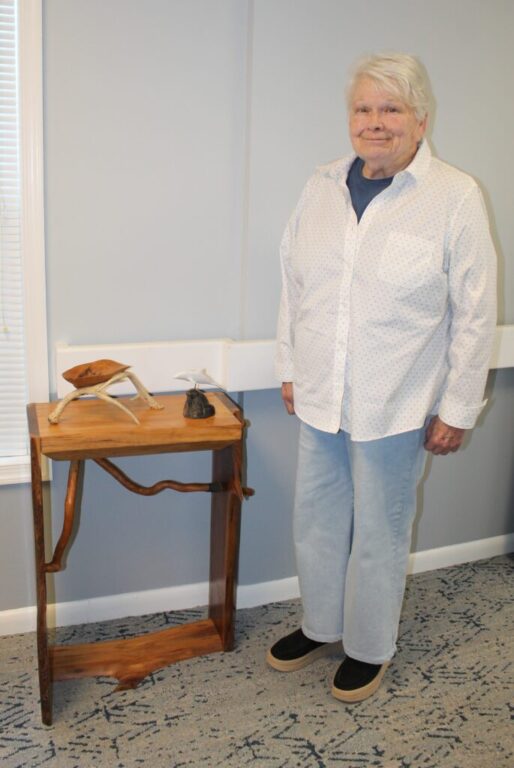
Mathews native Ida Trusch, 80, is a lifelong artist whose carved sculptures made of wood and other natural materials are held in such distinguished galleries as the Virginia Museum of Fine Arts and the Smithsonian Institution.
A 1963 graduate of Mathews High School, Trusch earned art scholarships from the Virginia Museum of Fine Arts and the Mathews Woman’s Club and went on to earn degrees in sculpture and art history at Virginia Commonwealth University. After graduation, she taught classes at VCU and Colby-Sawyer Women’s College in New Hampshire; designed décor for Kings Dominion; served as the director of the Exhibit Design and Fabrication Department at the Science Museum of Virginia; and established two independent art studios, one for fine arts and one for graphic design.
After living much of her adult life in Aylett, Trusch now resides in a senior living facility in Gloucester, where she is visited frequently by her beloved nephew, Christian Maggard. The two of them recently spoke with the Gazette-Journal about Trusch’s life and her art.
Trusch said her parents were the greatest influence on her art. Her mother Lela was a homemaker who had the heart and skills to be an artist, and she always provided Trusch with opportunities to engage in artistic endeavors. Lela did needlework and made rugs, and she was known in the neighborhood for the carvings she cut into trees, then painted.
“People would say, ‘Lela’s been in the woods again,’” said Trusch with a laugh.
Trusch’s father, Warren Trusch, was a lifelong Mathews waterman who taught her maritime crafts such as rope tying and line splicing that she eventually incorporated into her art.
Growing up in a waterman’s family, Trusch was exposed to painting boats at a young age, but she also taught herself to paint images. “Mother put a brush in my hand and said, ‘go to it,’” she said. No one taught her painting techniques or how to mix colors; she just did what came naturally, sometimes creating her own paints by grinding berries.
“It’s all in the doing,” said Trusch. “The exciting part of a painting is when it feels right, when it is right. You just do it.”
While in high school, she was recognized for her academic achievements, her sports accomplishments, and her art endeavors, with her artwork displayed in the high school library, Mathews Memorial Library, and the VMFA. She was already selling her art as a high school student, and one of her pieces was published in a Colorado publication, “The Western Horseman.”
When she began her college career at Richmond Professional Institute (which became Virginia Commonwealth University before she graduated), Trusch took formal painting classes, but she quickly became fascinated with sculpture. She was drawn to working in metals—casting steel, working in bronze, welding.
After graduating with a master of fine arts degree, Trusch taught at VCU for three years, then at Colby-Sawyer Women’s College for four years. While there, she became fascinated with wood carving and developed her own course to teach it.
“They were very receptive,” she said.
Trusch’s impulses drew her again and again to the ocean, where she picked up driftwood and other “wonderful things on the beach.” She would carry a feed sack with her when she went beach-combing and would end up dragging it back to her studio, loaded with anything she found interesting. She once took a whole day dragging a stump back with her. She ended up carving it into an abstract male figure.
Maggard said he recalled visiting her at Colby-Sawyer as a child with his father, who realized that some metals she had picked up while beachcombing and was melting down for castings were actually part of the ballast system for a Russian submarine and therefore classified materials. The two of them laughed at the memory, which included turning the materials in to the authorities.
Trusch came back to Virginia when she got a job designing the décor for the rides, shows, vehicles, and buildings at Kings Dominion in Doswell. Maggard said it was wonderful to visit her during the summer and go to the park with her every day, seeing how everything worked and helping out with small projects. One day, he attended a board meeting with her and was delighted, as a child who was taught to be seen and not heard, to be asked to help come up with a name for a park kiosk. He named it the Bandit Bar “and they ran with it.”
“It was fun to be around those kinds of people,” he said.
Trusch went from Kings Dominion to the Science Museum of Virginia, where she developed installations for the exhibits. She said her experiences there were very different from her other art endeavors and included such things as collecting specimens for one of her favorite exhibits—the Chesapeake Bay aquarium. Maggard recalled going with her to help collect the specimens, using a trawl net.
A graphic arts firm, established with Katherine Gilbert and called Trish Gilbert Designs, was Trusch’s next endeavor. She said the two of them began the business in the late 1980s, using a drafting table to create graphics the old way, before moving to computerized drafting in the 1990s.
After the shop close up in the mid-90s, Trusch went fully self-supporting at her studio in Aylett, designing the all-natural carved and assembled pieces she became widely known for.
Recently, a small collection of Trusch’s art pieces has been on display at Gloucester House for staff, residents and visitors to enjoy. Bowls carved from cedar and displayed on deer antlers found in the woods, tables with raw edges that have been stained or perhaps painted with a traditional Japanese Hokusai wave, fish or sea turtles or dolphins carved from wood and painted in natural colors. Each piece is strikingly original in concept and design, and all are utterly enchanting.
Maggard said Trusch has been a major influence on his own life. While he went in a different direction, serving in the military, he has always done some painting on the side, selling some pieces here and there.
“It was always great to be with her,” he said. “You could be a kid and be inquisitive and not be a nuisance. And, if you were a nuisance, she’d give you an art project to do.”
Trusch’s work can be seen on a number of websites, including behance.net/itrusch.