
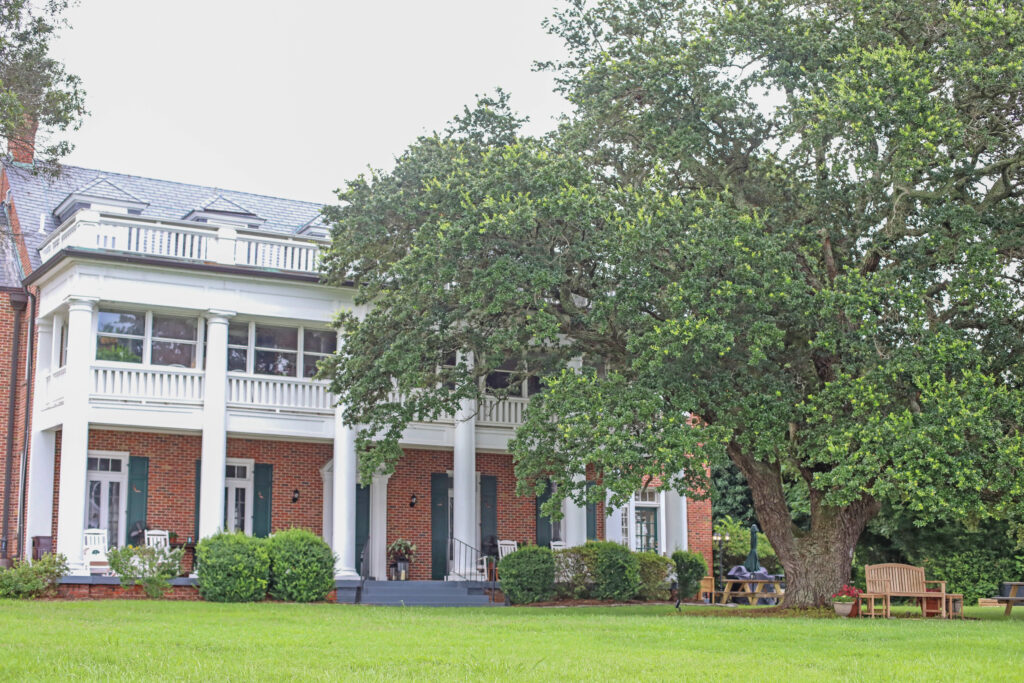
Together, the Gloucester Historical Society and the Woodville Rosenwald School Foundation created the video, “A Short History of Holly Knoll,” reflecting on the history of the historic building on the banks of the York River in Gloucester.
For this video, the Rev. E. Randolph Graham of the Woodville Rosenwald School Foundation and Philip Page of the Gloucester Historical Society, sat down with Civil War historian Dr. Wesley Wilson in the living room of the Moton Conference Center, on the property of Holly Knoll.
After happening across Holly Knoll by accident one day with his wife, Wilson recognized Pat Patterson, out on the front lawn during a celebration. Patterson lived down the road from the property and invited the Wilsons back to his home to visit.
The couple ended up purchasing the home next to Patterson and, after retiring from the military and starting a consulting business around 1988, Wilson was led back to Holly Knoll as a conference space for education primarily oriented to African Americans, he explained.
Wilson rented space at Holly Knoll, which was owned at the time by the United Negro College Fund. In his research of the building’s history, he found that his own use for the building matched its past use.
According to Wilson, Dr. Robert Russa Moton was looking for a home to purchase as he was planning to retire from his position as President of Tuskegee University, then Institute, in Alabama.
Moton’s second wife, Jennie Booth, was from Gloucester, and he followed her back to the area, said Wilson. “He bought quite a bit of property,” he said. “This property [Holly Knoll] and property from here down to Hickory Fork Road, but this was the site—he gave it the name Holly Knoll, that he wanted to build a house on.”
According to Wilson, as Moton got older and started facing some health problems, he began training a professor from Tuskegee—who was also his son-in-law, Dr. Frederick Douglass Patterson—to become his replacement as the university’s president.
An interesting detail about Holly Knoll that Wilson pointed out is that it was actually entirely built by Hampton and Tuskegee students. “The thing that amazes me is that its structure, in large, is still as it was as they built it in 1935,” he said.
“They built it as a work-study project because that’s what most of the African American, HBCU [Historically Black Colleges and Universities] as we now know them, did,” he said. “They trained the students for working careers … They were training people to be grunt laborers, to be workers and managers of sites—the men primarily. So that’s how this house got built.”
According to Wilson, Moton only lived five years after the house was built and had not spent much time in it. Wilson explained that many people question why Moton purchased the properties and built the house if he was nearing the end of his life.
His answer was that Moton realized how spread out black university and college presidents were and that they needed a support system for when times got tough.
“So, he said he wanted this house and this property to be an area where the black presidents of these universities could come and just relax, kick up their feet, or communicate with each other—even collaborate, you know,” Wilson explained.
Holly Knoll became a safe solace for the strategic thinking of the people for the civil rights movement, he said. They needed a place that was private, remote and protected, like Holly Knoll, with the forest, agricultural land and the river ensuring no one could sneak up on it easily. “People were coming here for the civil rights movement—coming down the river, to my understanding,” said Wilson.
“They would get off the train up around Richmond or at West Point, come down to the river, particularly white folks under the cover of darkness, join in the conversation, join in the planning, and then under the cover of darkness, get out of there. And for the black people, they could kind of merge into the community, so they weren’t as obvious as the white people.”
The property also gave birth to the United Negro College Fund, according to Wilson. “It makes sense that the United Negro College Fund was born here, because this is the first time and only place where all of these black college presidents could come together and develop a strategy,” he said.
Holly Knoll also serves as a site where Dr. Martin Luther King Jr. spent time, though he did not actually write his “I Have A Dream” speech under the historic oak tree on the property, known as the King Oak, as legend has it. “King, by his own admission, he sat there and his main interest, sitting on that bench under the oak tree, was to dream,” said Wilson.
“Not to write a speech, but to think about the things he wanted. And it’s interesting, because he was thinking about—King—about the same things that Moton was thinking about. Saying, ‘I’ve got to bring these folks together,’” Wilson said.
“I think the important thing of this property is not that any particular event came from the property—the thoughts of the events, the possibilities, the probabilities, the scheming, the dreams, the change.”
The Higher Education Act under Bill Gray also began at Holly Knoll, said Wilson.
Under William H. Gray III, who retired from Congress and became president of the UNCF, parts of the property were sold off. According to Wilson, two things were happening to cause this.
One, the property wasn’t needed in the same way it was previously, as communication and travel were easier and less urgent. And two, the properties were beginning to become a financial drain on the UNCF, which owned Holly Knoll after Patterson.
“The success of what happened in this room allowed basically for the demise of this facility, because now you could go out anywhere—and this became very expensive to maintain,” Page summarized.
“So, the success actually was doomed for this building, because now the vision is still great, but the need is not there any longer,” added Graham.
Now, however, keeping Holly Knoll running is exceptionally important, as it gives a view into an important part of the past, Wilson said.
“So, this place is still a strategic think tank, but we have to maintain it so that vision of Moton’s doesn’t die,” said Graham.
“I think that for this building—more than any other place else that I can think of in the country—the originating dream is still here,” said Wilson. He compared Holly Knoll to the historic oak tree outside.
The roots of the tree started an estimated 200 years ago and if you were to chop them off, the branches would die. “So, we’ve got to nurture the roots in order to keep that branch alive,” he explained.
“So, we have to maintain this building to keep that vision alive,” said Graham.
“We’ve got to keep this vision and maintain these properties, because all of the properties contributed as we evolved,” Wilson said. “They didn’t all come up at the same time, but they all came up for the same reason, and that was to allow us to gather in a safe and comfortable environment.”
When asked by Graham what Wilson wanted viewers to take away from the video, his answer was simple: “Holly Knoll will always be here,” he said. No matter the circumstances, the history and importance of the building will live on.
Today, under the leadership of Charles and Kay Coles James, Holly Knoll is home to The Gloucester Institute which, its website states, “It is our mission to train and nurture students that are emerging leaders across the country. TGI continues the work and memory of Dr. Robert Russa Moton.


