
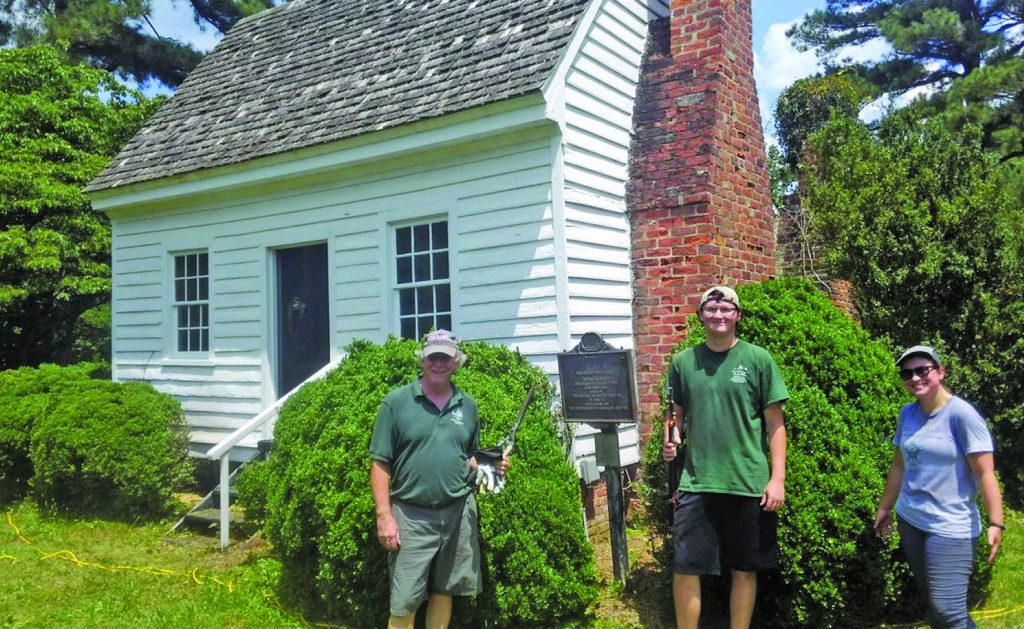
The Fairfield Foundation and the Gloucester Preservation Foundation will open Dr. Walter Reed’s Birthplace to the public on Saturday during Historic Garden Week in Virginia. In 1926, the Medical Society of Virginia saved the tiny house, and the structure has since become a well-known Gloucester icon located at the corner of Belroi and Hickory Fork roads.
“The birthplace represents one of the first preservation efforts in Gloucester County,” said David Brown, Co-director of the Fairfield Foundation and Chairman of the Board of the Gloucester Preservation Foundation. “It was once tucked behind commercial buildings fronting on Hickory Fork Road in the community of Belroi.”
In 1851, after a fire at the Bellamy Church parsonage, the small building was offered to the congregation’s new preacher, Lemuel Reed, and his family, which included five children and a wife who was expecting another child soon. On September 13, 1851, the Reeds welcomed their sixth child, Walter. Their son would go on to serve as a U.S. Army physician. He is best remembered for leading a team in the use of precise scientific methods to confirm the theory that yellow fever is transmitted by a particular mosquito species.
“The house is typical of a dwelling type prevalent in rural Gloucester and throughout Virginia’s Tidewater and Piedmont regions at the time,” added Thane Harpole, Co-director of the Fairfield Foundation. Tree ring dating of original structural timbers indicates the house was built in 1821 or shortly thereafter. There was one room on the first floor and another on the second. When interviewed later in life, Walter Reed’s brother said that the family was cozy and comfortable there. “Development and the changing needs of society since the mid-20th century have made the survival of this once-common type of house rare,” Brown concluded.
Visit Dr. Walter Reed’s Birthplace between 9:30 a.m. and 3:30 p.m. to tour the house and see the Middle Peninsula Amateur Radio Club, whose members will be on the grounds under tents displaying equipment and talking about their activities.

The Fairfield Foundation’s archaeologists will also be on site at Toddsbury in Gloucester and Palace Green in Mathews on April 17, while the homes are open for Garden Week tours. See related stories.
Brown said, “No less than five outbuildings from the colonial period were located immediately east of the main house. Over the last several years excavations have uncovered significant evidence of these buildings’ functions and construction.”
The foundation’s current work continues that research, including examination of the likely kitchen, Brown said.
Visitors to Palace Green will be able to watch Fairfield Foundation archaeologists at work as they search for evi dence of the dwellings of enslaved persons.
In 1860, when the home was occupied by owner Francis Armistead, his wife Sarah, and eight children, the property also provided a home for 14 enslaved persons, ranging in age from six months to 75 years, according to the 1860 Census and the 1860 slave schedule.
Brown of the Fairfield Foundation said a previous archaeological survey uncovered evidence of these occupants around the standing house as well as in the yard closer to the road. “Our excavations will focus on an area along the current driveway that may have included slave quarters in the early-to-mid-19th century. We are hoping to find evidence of the lives of enslaved Africans at Palace Green during that time, and share those discoveries with the community,” Brown said.

