

Gloucester Sheriff Darrell Warren is adding drones to his chest of law enforcement tools.
The use of drones can help the agency to save manpower and money in many situations, according to GSO Sgt. Brad Simmons, who is overseeing the drone program.
Simmons said the GSO is currently awaiting a certificate of authorization from the Federal Aviation Administration, which is required before public agencies may use a drone. He said there is a lengthy application to fill out for the certificate, and then the application has been completed and submitted.
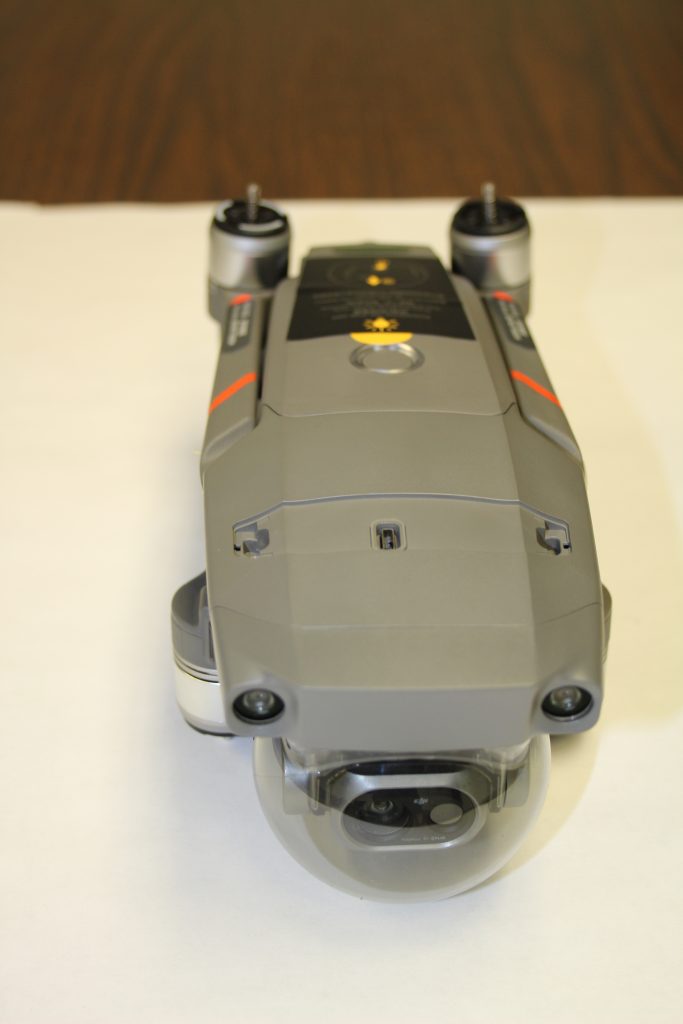
The drone collapses into a small unit that can quickly be slipped into a backpack along with its controller. The drone can be taken to a site and deployed in 15 minutes or less. 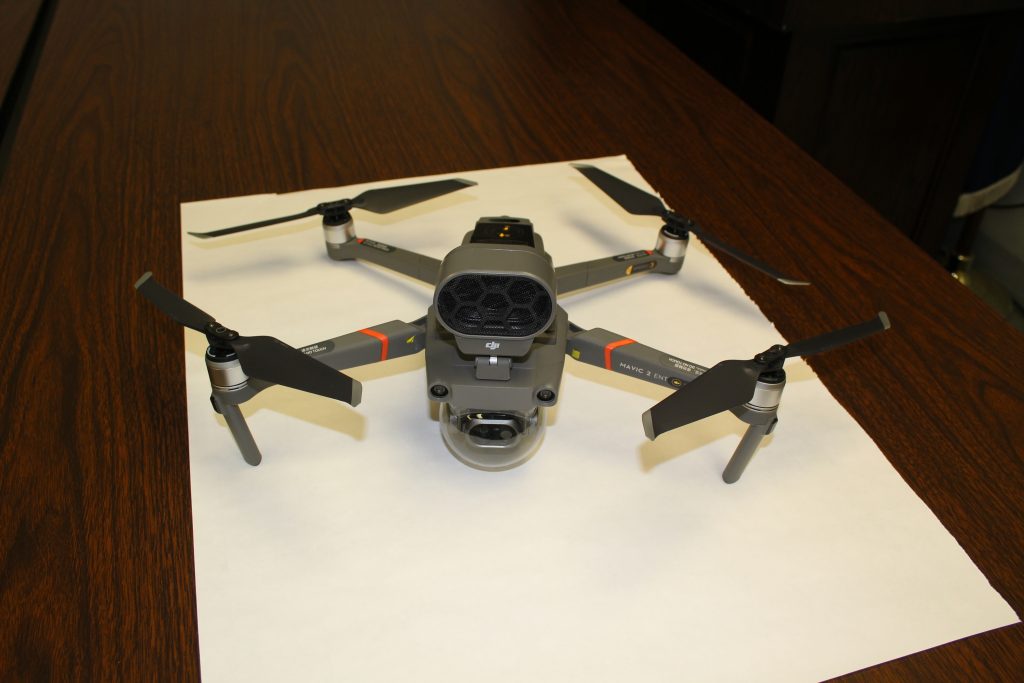
A GSO drone is shown with an attached speaker on top. The drone also has a search light, a beacon and infrared capability.
Once the agency’s certificate is in hand, the drone program will be fully operational. At least three officers—Lt. Scott Little, Lt. Jay Klink and Sgt. Nick Leaver—have already obtained their individual remote pilot’s license from the FAA and are ready to operate the GSO drones.
“Our goal is to have six pilots licensed, then we can have one on each patrol shift (there are four shifts), one on our special operations unit and one for investigations,” said Simmons. The GSO has two drones to utilize and both units are small and readily packable. Simmons said the drones only require 15 minutes or less to set up and launch.
Simmons said the drones cannot be used to violate someone’s civil rights or used in violation of search and seizure laws. However, they can be utilized if a search warrant is obtained. In executing a search warrant, the agency may use whatever tools it has available.
The drones can be utilized without a warrant in some cases, such as when an Amber Alert, Senior Alert or Blue Alert is activated. The drone can also be used when it is determined to be necessary to alleviate an immediate danger to any person. It can be used by a law enforcement officer to survey aerially a primary residence of the subject of an arrest warrant to formulate a plan to execute an existing arrest warrant or capias for a felony offense.
The drone can be used without a warrant to locate a person who has escaped custody or fled from a law enforcement officer who remains in pursuit of such person. Additionally, it can be used if a person gives consent. In no case may a weaponized drone be deployed in Virginia.
When a search warrant is obtained, the drone can by used to gather intelligence prior to the search and can be operated while the search is being conducted. Simmons said it can be used to help search for missing persons and operated while a crime is in progress to help locate suspects.
The GSO drones also have crash avoidance systems, search lights, beacons and speakers and they can be useful both outdoors and indoors. They are equipped with cameras and infrared systems for picking up on heat signatures.
Each weighs a little less than two pounds and has a maximum flight speed of 44 miles per hour. Simmons said they have flight times of 30 to 40 minutes when they have fully charged batteries.
“We could use it to negotiate with someone, for example, or to search for a suspect. If we needed to search Walmart it would be a lot quicker than men on the ground. Or if we had to look for an active shooter inside of a school,” said Simmons.
The drones can also be used to help with crowd control and to photograph traffic crash scene. Outside of law enforcement, Simmons said the drone can assist the county with damage assessments in events such as floods or storms, saving the expense of a helicopter survey. It could also be used to assist the fire departments as it battles a large and spreading wildfire.
While the drone can assist law enforcement, it can also be used against it. For example, Simmons said a drone can be utilized by a drug dealer to watch for police in the area. He also said there is no provision for law enforcement to defeat a drone.
Simmons said while awaiting the use of its own drones, the GSO has utilized the drone unit from the York-Poquoson Sheriff’s Office. He estimated they have used it about six times in the last 18 months. But calling in this mutual aid takes time which is not always available in emergency situations.
When the GSO obtains its FAA certificate of authorization it will be able to respond a drone immediately, as needed, and eliminate the need for one type of mutual aid.