
Press "Enter" to skip to content

Digital archive tells story of Gloucester A&I

A little-known, yet extremely significant piece of Gloucester County history is now available to the public online, with the recent addition of a digital database of original historical documents (along with transcriptions) of those documents on the Library of Virginia website.

The documents shed light on the founding and early days of the Gloucester Agricultural and Industrial School, also known as the Cappahosic Academy. That school, which operated from 1888 until its closing in 1933, provided the Black youth of Gloucester and surrounding communities with much more than the basic skills and training needed to be a laborer … the school provided a rigorous, top-notch liberal arts college-preparatory education that both preceded and exceeded public education offered to the area’s white students.

To find the archive, go to www.lva.virginia.gov and, enter “Gloucester Agricultural and Industrial School” in the search line, and click on “catalog.”
The papers had been in the Library of Virginia as part of a larger collection from William B. Weaver, the Cappahosic Academy’s first principal, who went on to establish the Weaver Orphan Home in Hampton. Between 1904 and 1965, the Weaver family cared for more than 800 children, with the family continuing the orphan home’s work after the deaths of William Weaver and his wife, Anna.

They had been part of the library’s collection on the Weaver Home when, several years ago, Bobby Ray’s daughter was doing some research at the library and came upon this treasure trove. The Library of Virginia has since scanned the documents and used a crowdsourced transcription site to make them more searchable and enhancing them for research.

“I was amazed that it was finished as fast as it was,” Ray said of the digitizing and transcription of documents. Kathleen Jordan, digital initiatives and web services manager for the Library of Virginia, oversaw the project, with volunteers transcribing the documents during the height of the pandemic.

These documents run the gamut, from tax receipts, teacher licenses, programs, newspaper clippings, correspondence and lists of donors to the minutes of the very first meeting in December 1887, written in the hand of the newly organized group’s first secretary, T.C. Walker.

“Each person present freely expressed their great desire to see a high school established in Gloucester County, and believed it could be done and should be done,” Walker wrote in taking down the minutes of that meeting, which was held at the Sassafras home of William and Anna Weaver.

There is also a program of the 1894 graduation, held in Douglass Hall, with the hall’s namesake—Frederick Douglass—delivering the address.

In this archive can be found the names of students and teachers, as well as a wealth of other information. Gloucester Museums Coordinator Robert Kelly said that the 38 items in this database could be a useful tool for those doing genealogy work. “That’s where I think the power of this comes,” he said.

Having these documents digitized and available for free online is a boon to historians everywhere. “They can sit in their house or anywhere in the world” and see these papers for themselves, Kelly said.

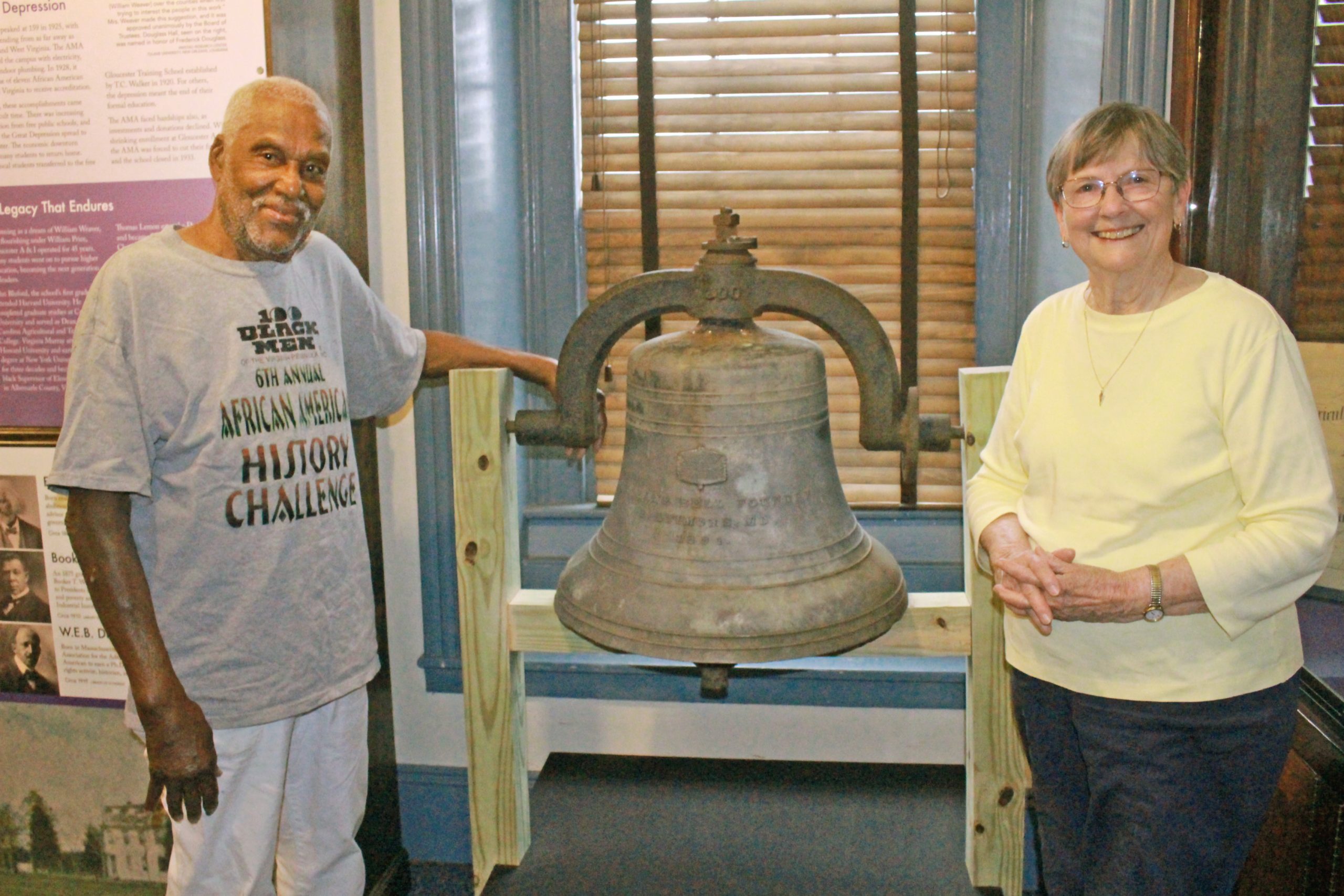
The Gloucester Museum of History currently has an exhibit that tells the story of the Gloucester Agricultural and Industrial School, from a wall of informative graphics, to the school’s massive bronze bell that is on loan by the descendants of the late Judge John DeHardit.

“At its heyday, it far exceeded the three white schools” in the community, said Dr. Wesley Wilson, president and executive director of the Woodville Rosenwald School Foundation. At one point, he said, Gloucester A&I taught three different foreign languages with world-renowned professors.

The school had more than one brush with fame. In addition to Douglass, the great contralto Marian Anderson once performed at the school, Wilson said.