
Press "Enter" to skip to content

Catching peeler crabs a family affair for Healys

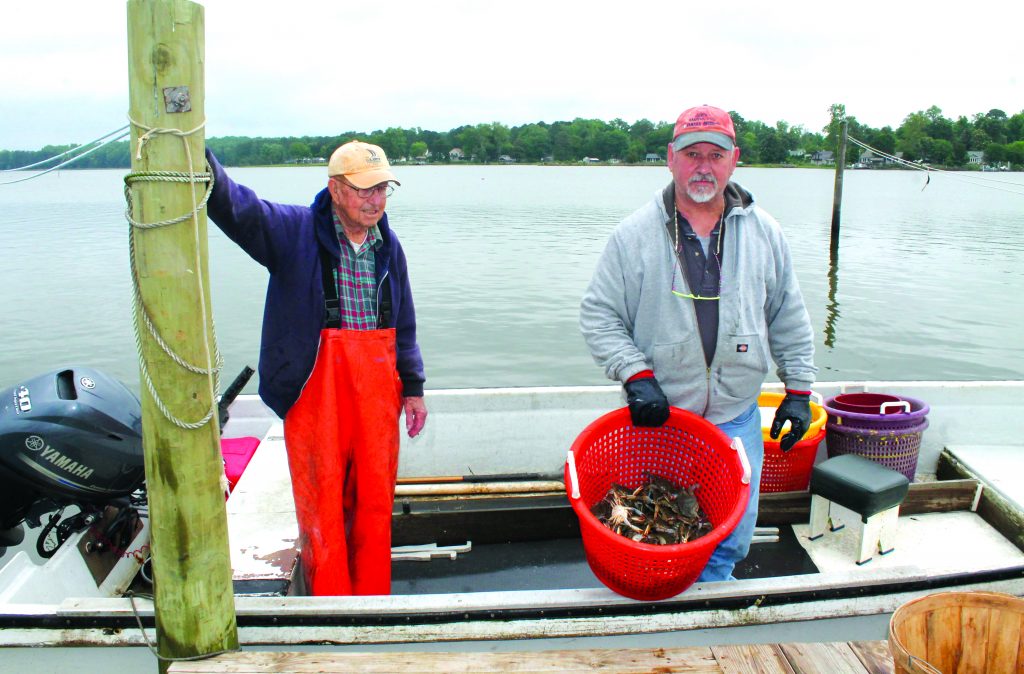
Max Healy of Gloucester and his son, Mickey, started catching peeler crabs together when Mickey was a teenager, and they’ve been peeler crabbers together for more than 50 years.

Max himself has been going even longer. Now 88, he’s been in the business for some 70 years.

On fair days during crab shedding season, which runs from April to as late as October, the two men get up early, drive down to the dock they built on a friend’s Ware River property, and load up in the 17-foot Seamark V-bottom skiff they’ve used for 30+ years. Then they head out to the peeler pots—large metal mesh traps—that they’ve set at various places in the shallow upriver region of the Ware.

At each pot, they tie off on the bamboo pole the pot is attached to, pull up the pot, empty it into the bottom of the skiff—crabs scurrying and the occasional fish flopping—and then drop the pot back into the water. They grab the crabs in their rubber-gloved hands, use measuring sticks to make sure they’re legal size, and toss them into baskets. Fish and crabs that are too small go back in the water.

“It’s not rocket science,” said Max on a morning in late May, his face lighting up with a grin.

Mickey said that in any given year, the two of them will pull in three to four bushels of crabs in mid-to-late May, or peak season, but during this trip, they only caught about half a bushel of legal-sized peelers.

“We’re off at least 75 percent this year,” he said.

Shedding the crabs

Peeler crabs are hard crabs, said Mickey, and the only way they can grow is to get rid of their hard outer shell. The outer shell splits and the crab backs out of it, leaving it as detritus on the sea floor. When its shell is shed, the crab is soft for a few hours, until its new shell begins to harden. But soft-shelled crabs are edible, shell and all, and are highly sought after by restaurants and crab connoisseurs alike.

Once the crabs are caught, the father-and-son team head back to the crab-shedding building located on Mickey’s property and put the crabs in the series of large floats the creatures will live in until they shed. That’s when Mickey’s wife Linda gets in on the action.

Four times a day during shedding season, Linda and Mickey visit the shedding house to select any peelers that are ready for market. Buckets in hand, they walk along the tanks, pick out any recently-shed exoskeletons and toss them in the trash, then place the crabs that shed the exoskeletons in their buckets. During the busiest days, Max joins them.

Once a crab is removed from the water, its shell stops hardening. The live crabs are placed in a cardboard box that will hold three dozen crabs of the same size. The sizes range from the 3½ to 4 inch “medium” to the 5½ inch or larger “whale.” Sizes in-between include the “hotel,” the “prime,” and the “jumbo.” No crab less than 3½ inches is allowed to be sold.

Not every crab is marketable as a whole, soft-shelled crab, but none of them are wasted. Some of them die while refrigerated and are removed from the box, wrapped in plastic wrap, and placed in the freezer. Ones that have missing fins or claws are cut up, frozen, and sold as “crab bites,” which are served as hors d’oeuvres in restaurants.

“Linda can clean a dozen crabs in less than three minutes,” said Mickey. “Five minutes if she wraps them.”

The boxes of crabs are placed in a large, walk-in refrigerator until there are enough boxes to fill a shipping chest that holds 12 dozen crabs. Mickey said that normally in May, when the crabs are running at their peak, there will be 15 to 21 chests ready for shipment each day to places as far away as Thailand.

“The busy season lasts maybe two weeks, and it’s a grind,” said Linda. “But then it dies down. I usually take a week’s vacation in May because I spend so much time down here. But not this year.”

Mickey attributed the slow season to the weather. The temperature was colder than usual for the time of year, he said, and there were continual northeasters for 15 days in May.

“Nothing good happens around here on an east wind,” he said. Warmer weather means more crabs, said Mickey, but that also means that the price “will bottom out.”

A lifetime of work

Max Healy has always been a hard-working man. On top of his peeler crab business, he worked full-time at Bailey Amusement Company for many years, all the while volunteering in various areas. He served as the head of his election precinct for 61 years, helped start Gloucester Youth Baseball in the 1960s, and when the city of Franklin flooded in the late 1990s, was there to help out the community afterward. Today, he is a driver for Meals on Wheels.

“He doesn’t sit around, and nobody else is supposed to sit around either,” said Mickey.

But, said Linda, “he’d rather do crabbing than anything.”

Max began his job at Bailey Amusement Company when he was just 16 years old, installing coin-operated arcade-style machines, pool tables, and other amusement equipment in various businesses on a commission basis throughout the area. When owner Gilbert Bailey died, Max bought the business. Mickey had started working there as a teenager, and after Max retired, Mickey ran the company until he retired and sold it. He then had a generator business for six years, but sold that a year ago and has been crabbing full-time ever since.

For her part, Linda had a 26-year career in banking before she retired.

“The whole time we were shedding crabs,” said Mickey.

While the peeler crab business is in a slump this year, the Healys aren’t ready to give it up quite yet. It’s always been a major part of their lives, and they’ll persist as long as Max wants to keep going.