
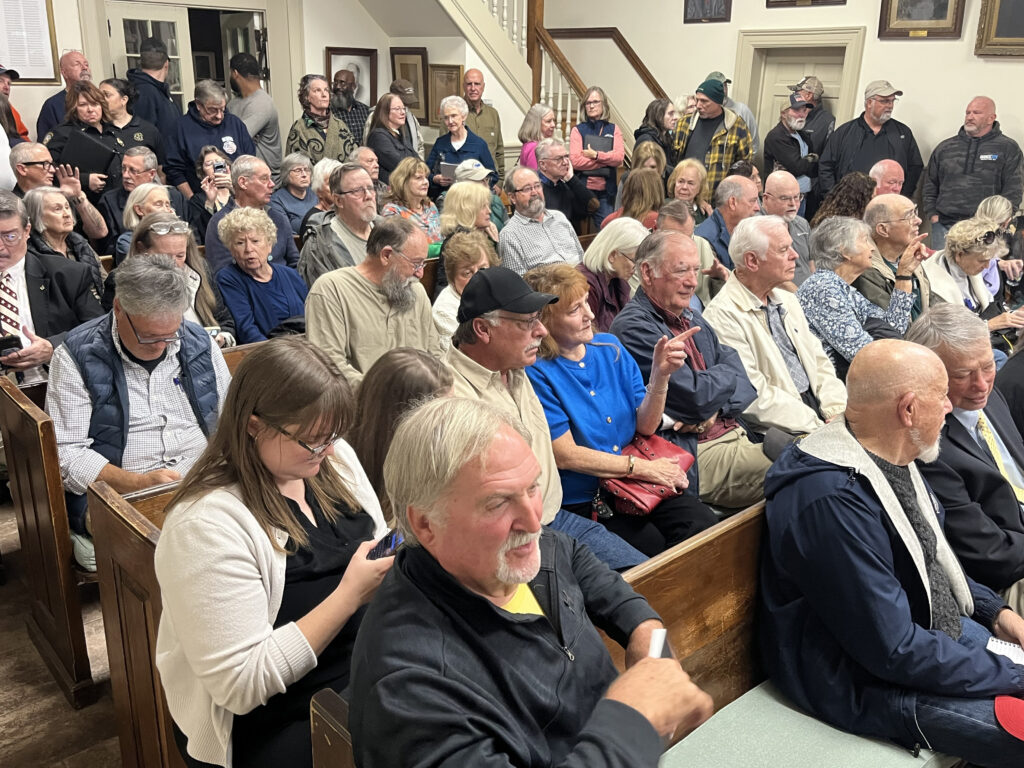
The Mathews Board of Supervisors voted unanimously last Thursday to have County Administrator Ramona Wilson move forward with negotiations on a contract with the Peninsula Regional Radio System and Motorola for an all-new public safety radio system for the county.
She was also directed to determine the costs associated with leaving the Middle Peninsula Regional Radio System.
The results of the negotiations are expected by Dec. 17, when the board will have a special meeting on the matter at noon. The regular board meeting will follow at 6 p.m. Both meetings will be in the historic courthouse on Court Street.
The decision followed a presentation by Wilson that compared the Peninsula system to the Middle Peninsula system, which the county is currently a member of and which uses L3Harris equipment. Wilson said that the county has already spent $1.8 million on the L3Harris system, and that upgrades would take two to three years to implement.
In addition, with L3Harris there would be unknown additional costs for commercial leases, there would be no interoperability with Gloucester, and there would be no lifecycle replacement. On top of that, L3Harris has a history of not resolving issues quickly and the equipment is almost out of warranty, she said, plus the Middle Peninsula system has had no policy team or operations team meetings over the past two years.
The Motorola system, by contrast, could be implemented in nine months, would provide interoperability with Gloucester, would give a trade-in discount on the L3Harris equipment, offers lifecycle replacement, has a local service team that can respond quickly, and provides all new equipment, said Wilson. The downsides to Motorola are the cost and the fact that changing out the equipment and dispatch consoles would be disruptive.
The matter has come before the board three times over the past three months, the first time in September, when Bob Brown, chairman of the county’s Public Safety Communications Committee, pointed out that the L3Harris-based system had been designed to provide 95 percent coverage outdoors, but that 95 percent coverage is needed indoors, as well.
In October, the board heard a presentation from the Motorola Design Team, whose representatives said they had heard from Mathews public safety personnel that there were frequent communication failures, including during hazardous situations, as well as requests for service that were never resolved, limited technical follow-up, lack of system governance, and other issues.
Motorola offered a solution that would provide blanket coverage by placing equipment on the WHRO tower at the elementary school and making use of the 10 towers the Peninsula system already has in place at a cost of $3.5 million–$4 million. This would require a tax increase of 2.467 cents per $100 of assessed value.
The L3Harris solution for the problem would be to either build two new towers at a cost of $3.2 million–$3.3 million or place equipment on two existing towers at a cost of $2 million or less. The changes would require a tax increase of 2.276 cents per $100 of assessed value.
Earlier this month, the board heard from Mathews deputies, dispatch center personnel, firefighters, and EMS personnel about the failures of the Middle Peninsula system and L3Harris equipment and their lack of confidence in them. They described emergency situations during which they had inadequate or nonexistent radio communications that left personnel vulnerable to danger, and asked that the county switch over to the Peninsula system and Motorola.
Wilson recommended that negotiations with Motorola include a 10-year lease with 5.64 percent interest, guarantees of 95 percent coverage both indoors and outdoors, and adherence to promises for equipment trade-in and discounts.
Sheriff April Edwards said she reached out to sheriffs in the area, some who use Motorola and others L3Harris, and she read their responses. Those with Motorola service provided glowing recommendations of the Peninsula Regional Radio System and Motorola, including reception, coverage, redundancy, reliability and quick response to service requests. None pointed out any issues. Participants in the Middle Peninsula Regional Radio System, in contrast, did report issues with reception, coverage, and system failure.
Supervisor Janice Phillips said she was struggling with a decision because of the increase in the tax rate it would require and the effect that would have on people on a fixed income. She also said she struggled because of the urgency and having to make a decision without a complete analysis.
Supervisor Pat Beattie said he would prefer to use a consultant to analyze the issue before making a decision.
Chairman Tom Bowen reminded board members that the decision was not which system to go with, but to allow Wilson to nail down the details of a possible contract.