
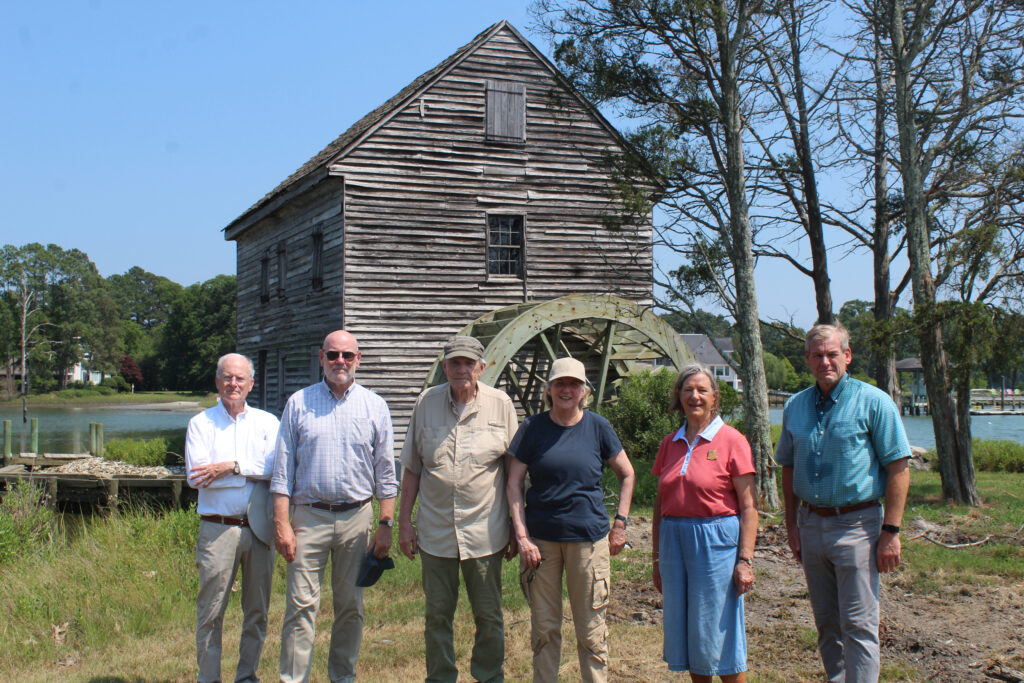
The newly formed Poplar Grove and Tide Mill Foundation has acquired the historic mill and the Poplar Grove Estate, located on the East River between Mathews Court House and Port Haywood.
The group’s goal is restoration of the mill and making the land available to the public for education purposes. The foundation is made up of four members: Conrad Hall, David Lowe, Lynne White and Josie Thorpe.
The mill house is a two-story structure built on a narrow stretch of land separating the mill pond from the river. During the mill’s operation, the rise and fall of the tide was used to turn the large wheel on the side of the building, grinding corn. It has undergone restoration once before, but is in need of repair again.
The former mill was built pre-American Revolution and was said to have milled corn for George Washington’s army during the siege of Yorktown. In 1862, the mill was destroyed by the Union Army during the American Civil War. “They came up the East River and by cavalry,” said Lowe. Many mills and boats were destroyed during that time. In the late 1860s, the mill was reconstructed and is what stands at Poplar Grove today.
“This mill is one of four or five tide mills left in the United States,” said Lowe. “We had someone from SPOOM (Society of the Preservation of Old Mills) walk through and he said it might be the only one left with original gears inside.” There had even been questions about tide mills that this mill had made clear for SPOOM, he added.
The foundation has a millwright coming to look at the mill. In 2010, the same millwright had done a full assessment of the mill. “Lynne called him, and he jumped at the chance to see the mill again,” he explained.
Though the mill may not run again, the goal is to preserve it, as it is an important part of Mathews history. Lowe highlighted an idea of Conrad Hall’s: creating a replica 3D model inside the mill to show how the machinery used to run.
The Poplar Grove house is a two-story structure not far from the mill house. The kitchen, Josie Thorpe explained, was likely built in the late 1850s, early 1860s, and remodeled in the 1950s. The columns on the front of the house, which overlooks the water, are assumed to have been added around 1880. “The original part of the house is from the 1740s,” she said.
The house has four staircases, multiple fireplaces, an elevator, and an attic room named the Crow’s Nest. Nearly every window along the water side of the house looks out over the tide mill and the East River. “We think the interesting part is that the clapboard—that’s the outside of the house. There is no insulation or anything, that’s just the outside of the building,” Thorpe explained.
Sally Louisa Tompkins, a Confederate nurse and the only woman to be commissioned as an officer in the Confederate States Army, was born at Poplar Grove. The homesite was purchased by John Lennon and Yoko Ono in 1980. After Lennon’s death, “Yoko gave the property to a boys’ home, so they took it over,” said Thorpe. The New Beginnings Boys’ Home, however, “couldn’t afford the mortgage on it, so they put it up for auction.”
“There’s a famous photographer, Frances Benjamin Johnston … she was hired to photograph disappearing architecture of the South,” said Hall. Poplar Grove was one of those places she photographed, and the photos can be found in The Library of Congress.
“We heard it might be sold to a developer and they didn’t care about anything on the property,” said Thorpe. She then told White, whose ancestor had been the last miller for the tide mill in the late 1800s, early 1900s.
“We always say, it’s really one of the county’s treasures and part of the soul of Mathews and our hope is to be able to preserve it, if we can,” said Lowe.


