
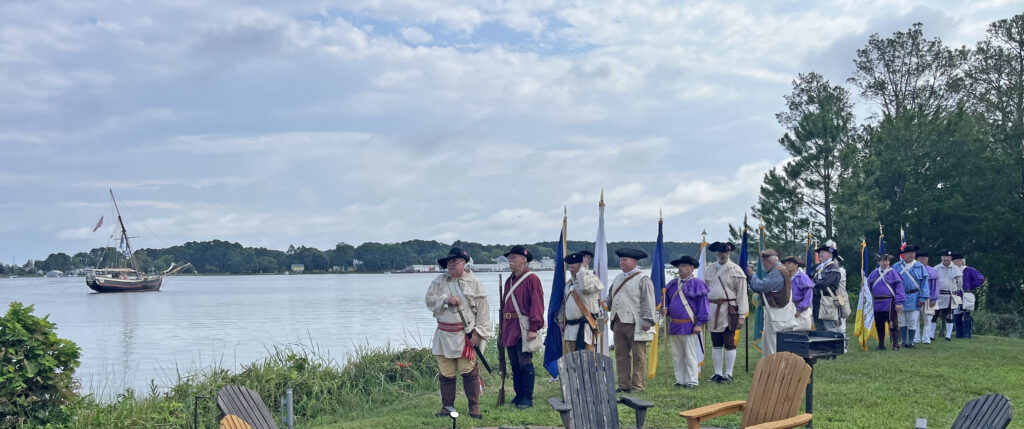
The 250th anniversary of the Battle of Cricket Hill/Gwynn’s Island was celebrated in Mathews last Thursday with flags, patriotic music, cannon fire, the unveiling of markers, and inspirational addresses by a range of dignitaries and officials to a crowd of over 300 people.
Michael Rhodes, past president of the Richard Henry Lee Chapter of the Virginia Society of Sons of the American Revolution and organizer of the event, called the ceremonies to order and oversaw their execution.
Fred Lyon, chair of the Mathews VA250 Committee, told those gathered that it had been clear from the initial statewide meeting of VA250 committees that Mathews, “because of its historical significance, was going to play an important part.”
Among the reasons for this, he said, was that Capt. Louis d’Ohicky Arundel was the first French officer in the Continental Army to be killed in the Revolutionary War after the signing of the Declaration of Independence on July 4, 1776. He died on July 9, the same date that the ceremonies were held.
“For 250 years, the U.S. and France have come to each other’s aid in times of existential crisis,” Lyon said. “We look forward to 250 more.”
Thierry Chaunu, president of the American Society of Le Souvenir Français, which maintains the graves of over 5,000 French soldiers, sailors and airmen buried in the U.S., spoke about Arundel, an artillery captain who “volunteered to fight and make the ultimate sacrifice for American independence.”
“His story is the story of the over 30,000 French soldiers who fought for U.S. independence,” said Chaunu. “Today, 250 years later to the day, we honor him.”
According to an article written by Dr. Patrick H. Hannum and reprinted in the event program, Capt. Arundel was a career military officer who had served in the French garrison on Saint-Domingue, or present-day Haiti. He made his way to Philadelphia, where he joined the Continental Army and was charged with recruiting and training men for artillery service. During the fighting at Cricket Hill, he “attempted to fire an experimental mortar that exploded and killed him.”
The unit Arundel recruited “would later, in the fall of 1776, grow into the 1st Continental Army Regiment,” said Hannum. “Fortunately, Arundel trained his men well … Captain Louis d’Ohicky Arundel is indeed an original Virginia Patriot.”
Caroline Monvoisin, Consul General of France in Washington, D.C., said that Cricket Hill “marks one of the first victories in the Revolutionary War.” Fought before France had agreed to join the war, the battle proved that the new nation “could also be defended on the battlefield,” she said.
The Battle of Cricket Hill “reminds us of the friendship of our two countries—forged on the front by people who believed that freedom was worth defending,” said Monvoisin, recounting the U.S. coming to the defense of France in two world wars.
Col. Antoine Fleuret, French National Liaison to Allied Command Transformation, NATO’s Strategic Warfare Development Command at NATO Headquarters, spoke of the shared duty and discipline that can overcome the language barrier among soldiers, and of how soldiers “are no longer French and American, but a brotherhood of arms … born in the training camps and on the field.” He called for a moment of silence to honor Arundel “and all who died for American independence” before unveiling the bronze marker placed at the site in Arundel’s honor.
A second ceremony was held to dedicate a Road to Revolution Battle of Cricket Hill sign at the site. Rep. Rob Wittman (R-Montross) spoke of the Battle of Cricket Hill as “a tipping point.”
“If these things don’t happen, we don’t have the country we have today,” he said. “We honor those who put their lives on the line. These are the things that make a country great.”
Retired Ambassador Randolph Marshall Bell spoke of the sacrifices made by those who fought for U.S. independence and of the importance of honoring “our ancient Franco-American alliance.” He was followed by Jeffrey D. Thomas, National Historian General for the Sons of the American Revolution, whose ancestor Cpl. David Baker of the 3rd Virginia Regiment wrote, “The first service that I saw was the cannonading of Gwynn’s Island against Governor Dunmore.”
Thomas said that Cricket Hill “holds a special place in my heart,” and that the Richard Henry Lee Chapter of the Sons of the American Revolution had done “a fantastic job” with its annual celebrations of the Battle of Cricket Hill, growing community support for the event each year.
A third ceremony included welcomes by representatives of various patriotic organizations. They were Dr. Dennis Martin, president, of the Richard Henry Lee Chapter, Virginia Society of the Sons of the American Revolution (SAR); Rhodes; Mary-Alice Emerson, regent of the Cricket Hill Chapter of the National Society of Daughters of the American Revolution (DAR); and Drew Wajciechowski, State 1st Vice President of Children of the American Revolution (C.A.R.).
Bringing greetings from their organizations were Michael J. Elston, president general of the National Society, SAR; Darrin Schmidt, president of the Virginia Society, SAR; Kathleen Mayer Rugh, state regent of the Virginia Society NSDAR; Robert Kelly, historic resources supervisor for Gloucester County and member of American Friends of Lafayette; and Mark Jacobowski, general president of the General Society Sons of the Revolution and president of the Virginia Society Sons of the Revolution.
The keynote speaker was Andrew Lawler, author of “A Perfect Frenzy,” which details the actions of Royal Governor Lord Dunmore during the American Revolution and includes a chapter about the Battle of Cricket Hill.
Lawler gave an outline of the action that day, saying that “five days after the U.S. was born, Gen. (Andrew) Lewis lit the first cannon here, on Cricket Hill,” resulting in smashing Dunmore’s fine China, injuring his leg, and damaging his ship, with the result that “never again would the British control Virginia.”
But Lawler shattered some of the ideas that people had about Dunmore—ideas based on legends that had been passed down for generations. He said that, contrary to the image of the rogue that history has painted Dunmore to be, he was actually a popular governor who was friends with George Washington and returned to Williamsburg a hero after doubling the size of Virginia. Only when he oppressed the patriots did he become “the essential bad guy,” said Lawler.
“Rumors were spread about him, and they stuck.”
While lore says that Dunmore “dismissed the colonists as crickets,” Lawler said that, after going through all of Dunmore’s correspondence and accounts of the battle, “I couldn’t find it.”
“I talked to historians who said the term came to life only much later,” he said.
Another misconception that people have is that Dunmore’s fleet contained mostly British soldiers, said Lawler. Instead, it held “liberty-loving Virginians—escaped slaves.” Becoming a black loyalist was different from becoming a Patriot, said Lawler, because it involved risking your life “just by making a dash to join.”
“The slaves fought for freedom,” said Lawler. “What’s more American than that? We need to honor all those who fought for liberty, no matter the color of their skin.”
The ceremonies included a presentation of colors by a joint SAR/French military color guard; renditions of the French National Anthem by soprano Laura Heydt and the U.S. National Anthem by Musician 2nd Class Brenton Mitchell of the U.S. Navy; musket salutes by the SAR Color Guard; Road to Virginia’s Independence medal awards by Dr. Kenneth Hawkins, national trustee of the SAR; and an invocation and benediction by John Kuvakas, state chaplain for the Virginia Society SAR.
Additionally, 41 wreaths were laid to commemorate 41 organizations and organization chapters.
The celebration continued throughout the weekend, with Revolutionary War reenactors holding events on Saturday and Sunday at both Morningstar Marinas and at the Gwynn’s Island Civic League building.